Wednesday, March 31, 2010

DREAM OF HAVING AN AMATEUR PIANIST AT HOME

We both have no music talent unfortunately. My hubbie loves listening to music but he does not know how to play any musical instrument. And despite my parents' great effort and investment to discover any untapped artist talent inside me, they eventually gave up after my private keyboard tutor frankly told them that I am kind of music deaf. And the only music-related thing I could keep in my mind is simply the beginning music notes of the song "Silent Night" which starts with "sol la sol mi...".

As a result, we hope to invest in Mew's music appreciation ability since her school age so that she can know how to play a musical instrument. Needless to say, even being an amateur music player, she will have more advantage in her personal and social life. Therefore, on her birthday, we decided to give her a musical keyboard (after having consulted with her of course). Mew had no clear idea of which instrument she liked or wanted to play so we chose the electronic keyboard which seems to be easy to play and carry. If she expresses any substantial interest in this keyboard, we will upgrade to a piano and invite a private tutor to teach her formally. 

I tried to google some easy piano lessons online so that I myself can imitate and learn to play the keyboard first then teach Mew later. It was a bit difficult initially when I even could not read the music note. But with some more searches, I finally found out something really useful for a beginner. Moreover, I learnt from our keyboard's guide book that this one has some teaching functions so that a player could simply repeat the same music keys on the screen in order to play well some popular songs. My husband now even can play the song "When the Saints go marching in" and I can play other very simple songs such as "Happy Birthday to you", "Twinkle twinkle little stars' and "Frere Jacques". How amazing it it! Mew has been able to play the first part of the song "When the Saints go marching in" and I noticed that her fingers worked very well on the keyboard. However, she has not yet developed a great interest in playing keyboard so we still have to wait and see.
Here are some very useful website to learn it yourself how to play pianos:
- A virtual keyboard-piano: You can even play the music on a keyboard/piano anytime without having one. Fantastic!
- Youtube video to teach you hand-on experience of playing the song "When the Saints go marching in"- this is my first online piano lesson ever!
- Music Tech teacher can help you to play the keyboard/piano with or without the official knowledge of music notes. Go to the section "Flash Piano Practice Keyboards" to find samples of songs including Frere Jacques, Jingle Bells, My country tis of thee, Chpstix, Ode to joy, Twinkle twinkle, When the saints go marching in, Surprise symphony, and Love somebody. Extremely useful for a beginner!
- 5 video lessons will have you learning the basics, and playing your first song, in less than fifteen minutes!
- Ready to venture more into the realm of music? Music Theory Online is a great site that teaches you all aspects of musical theory in a series of Flash-based lessons. Learn about notes, clefs, scales and much more.
- Music for a phone keypad can help you to kill the waiting time for fun.

Good luck with your kid's (and maybe your own) music journey!


Wednesday, March 24, 2010

LUNCH IN A BOX

Last year at the daycare, we did not have to worry about Mew's lunch because it was included in the tuition. The daycare teacher also helped the kids to eat their lunch and the atmosphere was very comfortable for young kids. It is totally different at the kindergarten however. Kids must bring their own snack and lunch to school and the lunch time is very limited with only 1-2 minutes for warming their lunch in the collective microwave. Although there are supervisors at lunch but they do not "help" kids as before. Consequently it becomes a headache for parents to prepare their kid's lunchbox to ensure a proper nutritious value but it is not too complicated for kids to handle it by themselves. It cannot be too much either because kindergarteners are often not able to finish a big lunch within 30 minutes. It should be easily frozen and defrozen or microwaved so that kids do not have to wait too long for their meal to be warmed. It should be also attractive enough so that kids do not get bored with their lunch, etc. A lot of things need to be taken into account.

Although I am very admired at Biggie at Lunch in a box, I unfortunately am not as talented as her nor love cooking enough even for the sake of my kids to venture myself into a lunch-preparation journey. So, I decided to make it simpler for both me and Mew. Luckily, Mew is not a picky eater and normally she eats what I prepare for her, and sometimes she is even more than happy with the same meal for all 5 days in a row if she really likes the ingredients. Thank you, Mew, for your complete change in eating habit since your age of 4. If not, we parents would have already died from exhaustion to cater for your food needs.

Here is some pictures of Mew's lunchbags. The Princesses one can be put inside a medium-sized backpack but the two-compartment California Innovations lunch bucket cannot fit Mew's daily backpack so she has to remember taking it back and forth (she has forgotten twice so far but luckily found it later).


The most frequent lunch I prepare at home for her from scratch includes fried pasta with vegetable and soy sauce, glutinous rice made in shapes with seaweed and shaped boiled egg, mashed potato with cheese, milk and egg, fried mixed rice, sandwich bread with slices of cheese and ham made into funny shapes.

 
This is the lunch for tomorrow. Mew insists on having her "fake sushi" so I cooked glutinuous rice with grean bean and molded it while still very hot to make star, heart, flower, triangles and onigri shapes. I used seaweed to roll around each shape and also cover their facets. Next compartment is fresh vegetable, namely carrots, mushroom and olives. I put a small container of Ranch sauce for Mew to dip the veggie. To ensure the protein input, I boiled an egg and molded it into a fish shape. Finally, for her dessert, I tossed in some Funcheez (dinosaur-shaped cheese) and Allens fruit punch.

 
This "obento imitation" lunch was from last week. The same recipe with "fake sushi". The egg was mold into heart shape and cut into halves (due to the lack of time, this egg did not shape well). I did not forget vegetable with mini carrots and steamed cauliflower florets. I grilled a hotdog then cut it small and poured some Heinz ketchup sauce (Mew prefers chili sauce but she coughed a lot so I did not allow her to touch any spicy ingredients).

 
The most popular mixed fried pasta with a lot of kinds of vegetables, frozen imitation crab or sometimes cooked ham, pasta sauce or soya sauce, olive oil and voila ... enough for 3 ready-to-go meals in the freezer.

Quick and easy - toasted sandwich bread slice cut into snowman, Xmas bell and frog shapes by cookie cutters with cheese slice of the same shape in between. I tried to make a funny face for the snowman but finally his eyebrows made him a bit scary instead. Mew's lunch cannot be without some veggies so I tossed in mini carrot and olives. To add some more flavours, I grilled a BBQ hotdog with some melt cheese and dropped a little ketchup sauce.

 
Very traditional recipe of mixed fried rice with enoki mushroom, jambon, asparagus and egg. Seasoned with soy sauce as usual.

  
For her snack, I put button cookies, banana, apple, strawberry or blueberry, grape, etc. For her beverage with lunch, I give her juice, Kool-aid jammer, soy drink, etc.


And above is her ustensil kit including spoon, fork, chopsticks, toothpick, tissue, ice blanket or ice pack, toothbrush and small cup for oral cleaning after lunch.

Sunday, March 21, 2010

IT IS SO IMPORTANT TO HANDWRITE NEATLY AND BEAUTIFULLY


Mew's writing has been significantly improved since our last home visit when we invited a private tutor to teach her to read our mother language. Though at that time Mew was really reluctant to learn both reading and writing and we did not focus much on writing skills, the long-term effect of an intensive course with discipline and a lot of homework proved to be very positive to her handwriting currently. I could proudly say that Mew's handwriting is not only the best in her class but also much better than her teacher's. Here is an example piece of her handwriting (and don't forget that she has just begun learning how to write within 1 month only - and since we came back here we have almost had no time to schedule her writing practice session):


It seems not to be surprising at all when the pedagogique method here does not consider it important to teach writing neatly and beautifully. For the teachers, it is more important that their students recognize well the letters and the students are encouraged to write them correctly. It appears to us that here they prefer to apply the democratic idea to everything including primary education and thus it is totally free for the students to express their own characters through free writing without any discipline or model to follow strictly. But in our home country, to write correctly is far from enough for a good student. She or he must learn to write neatly, beautifully, almost perfectly. And the teachers there use marks on the scale of 1-10 to evaluate the handwriting practice work of each student. It is impossible to tell if one method is better. But for us, to handwrite neatly (and beautifully to a prescribed model) is an important way to teach the students the patience, the diligence, the continuous efforts to practise daily, the discipline, the organization skills, etc. since their early childhood. In short, one's handwriting would reveal parts of his/her characters.

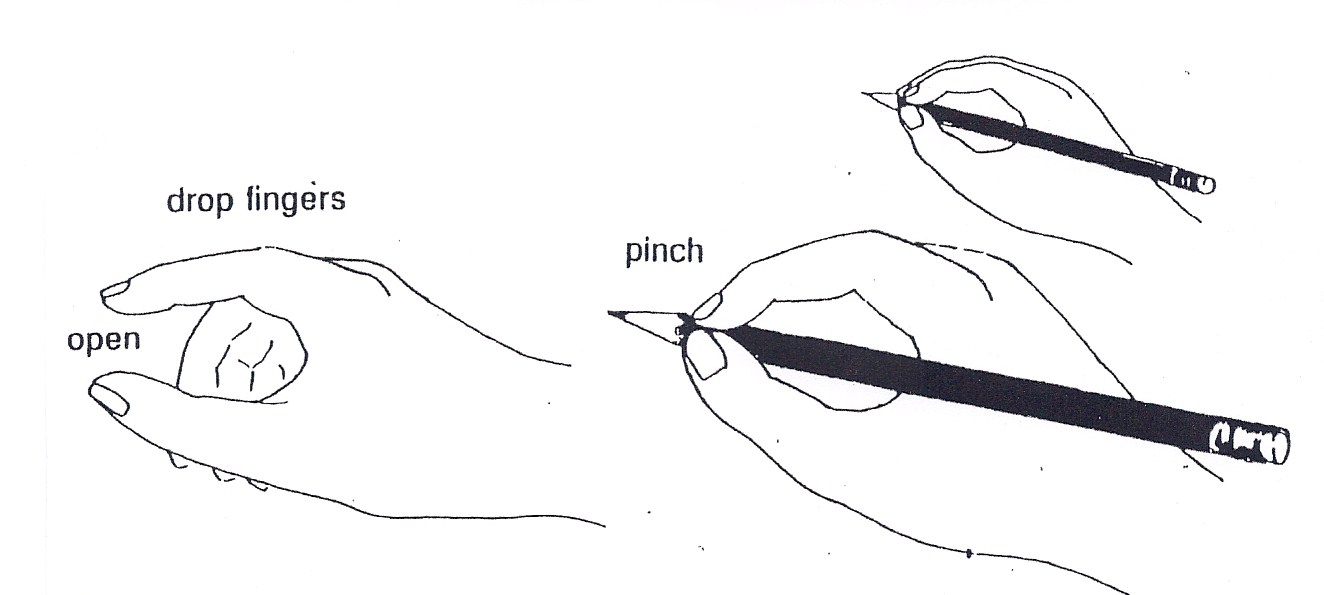
The Light Educational Ministries Phonics Manual shows you how you can teach writing formations and lists "Three P's of Writing Preparation: Posture, Pencil Grip and Paper Position." The LEM manual lists these important rules-

  • Posture
    • Sit with buttocks pushed to the back of chair.
    • Have feet flat on floor (use a footstool is the chair is too high).
    • Head should be held up, not drooping forward. A drooped head strains neck and back muscles.
    • Back should be straight, with the trunk leaning forward from the hip joint for a comfortable writing position.

  • Pencil Grip
    • Use a six-sided (hexagonal) pencil. Hold it between thumb and middle finger. The pencil should be held lightly enough so that it can be pulled out of the hand easily, but firmly enough to maintain good control. Hand and finger muscles should not be tightly tensed.
    • Write with the point of the pencil and hold it just above the shaven area.

  • Paper position
    • The side edge of the paper should be parallel to the arm holding the pencil. The other hand should rest above the writing to steady and move the paper up and down as needed.
    • The left-handed student will do the same, but the paper will be at the opposite angle. Be sure that the left-handed student rests his pencil hand below the baseline, not above the writing.
And some tips from kindergarten teachers who have been working with kids to teach them how to hold a pencil correctly:
- the 'driving' grip: The thumb is the steering wheel and index is mum and dad driving, the 3 kids are in the back but the middle one is learning to drive so she watches closely but sometimes she is naughty and tries to get into the driver's seat.

Further resources on teaching handwriting to your kids can be found at these sites:
- How to Teach Handwriting (techniques)
- Teach your child to write (a collection of references and resources)


Monday, March 15, 2010

WHEN A KISS SHOULD BE A REAL KISS?


I was so uncomfortable, embarrassed and awkward when Mew tried to kiss me on the lips one day, lol, a real passionate kiss. She leaned back down to my face and held my head to search for my lips and tried to let her lips touch my lips. She wanted a lip-lip kiss!!! Since her birth, I have kissed her foreheads, her nose, her cheeks, her neck, her hands, her feet, her belly button, etc. but never her lips. Answering my question why she had such bizzare action, she told me innocently: "It's love, Mom. The way they kiss each other in the movies. Like the prince and Cindrella or other couples". Oh my God, that's where she got her idea of expressing her love to me in a physical contact of lips, ewhhh!!! So even though we do not have a cable TV so that her screen time could be controlled, we do have a DVD player and children's classic movies. I did not even pay attention that the two main characters of some movies exchanged their real kiss and I have also never expected that scene in a children's movies. But surely that's the only source of Mew's entertainment and she must have learnt how to kiss from those movies. Well, so what should I do now to explain to her that such way of kissing is not appropriate to her age? What if she asks why the adults can kiss on lips but not children? Should I just simply say that a lips-lips kiss is only lovers' kiss?

Wednesday, March 10, 2010

WANNA BE A MAGAZINE COVER STAR? TOO EASY!


Parenting Cover Model Maker Think your little darling's cute enough to be on the cover of Parenting? This Cover Model Maker can take an ordinary digital pic and turn it into the cover of Parenting. It takes just minutes, it's easy, and it's free! - Accept various file extensions including JPG, PNG and GIF - Headlines can be modified to your preferences - You can either print out the personalized cover or download it to your computer or email it to your friends!

Cannot resist the temptation of showing off your kids on the cover of
Today's Parent magazine published in Canada? Simple use their online cover maker and voila, a real magazine cover with even a barcode is ready for you to proudly send to your friends or to print out right away.


American Baby magazine Cover Maker Who does not love the idea of putting her adorable baby on the cover of American Baby magazine? Plus, you can customize your cover with different layouts and personal cover lines. Cons: Only JPEG files under 1MB accepted. No option of download the file to your computer.
Parents offers the same Magazine Cover Maker to its website registered members. It takes you, however, 1 more minute to be able to access their free tool because you need to fill in a form to register your username, password. But this online cover maker allows you to upload up to 6 photos at a time to your album and choose among 3 magazine covers including "Parents", "American Baby" and "Family Circle" to show off your kids. Furthermore, you can even add add graphics, frames and text to your photos to make them more attractive and more professional. Be sure to click on the button "Want to be a cover model? Make a magazine cover" to get back to the Magazine Cover Maker after completing your album build-up and follow their instructions to view finally your cover.
A similar online cover maker with the same cons can also be found at Your Pregnancy.

You can even create your own magazine covers with the ready-made templates like "
My Child", "Parenting", "Baby" or "Kid".

Somehow more complicated but more creative to make your own magazine cover from scratch,
Big Huge Labs offer a free online magazine cover maker that allows you to upload your pics not only from your computer but also from your Flickr albums or Facebook account.

And, is it even more fantastic if you can have your freshly-made magazine cover printed and shipped to your door? Sure that you can. Print out your collection of magazine covers in the form of a FREE photo book offered by HotPrints and get free shipping - Yes, totally FREEEEE! No catch at all! One photo book (HotBook) every month for (free) registered member (
This offer is currently limited to HotBooks to be shipped to addresses in the US, UK and Canada only).

Monday, March 8, 2010

MEW'S HAPPY WEEK

Last week was the Spring break here and Mew did not have to go to school, hoorray!!! So she just stayed at home with us and enjoyed playing games alone or with parents.

I took Mew to the Grande Bibliotheque with the aim to getting her and myself library subscription cards but unfortunately we forgot our proof of address and finally came home in vain. However, I did get a remote access to the library's electronics resources simply by filling in an online form. It is in fact more useful for us since we might not have enough time to go to the library in person but we could use the library's portal with the authentication to get the access to various interesting database. Youth Space or L'espace jeune is undoubtedly among the most favourite destination for Mew during her learning journey here.

I babysat Mew and Helen, her best friend, for two mornings. We played some simple games to reinforce their French vocabulary. Helen's French now appears to be better than Mew, mostly thanks to her special passion for learning everything and also because of Mew's 2-month absence from the French school. We will need to work with the private tutor to help Mew more in improving her French oral communication skills.

A good news is that Mew seems to become better with her mathematics addition skills after some practice with me. Although she does confuse sometimes between numbers such as 19 and 91 but generally she can presently add up to 20 without much problems. I used the game board of Snake and Ladder game to teach her to count up to 100. Then we taught her to do some basic additions using her fingers. The important thing we taught her at the beginning is the communitative characteristic of addition problems, where 5+8 = 8+5. Based on that characteristic, we instructed her to focus on the bigger number in the addition problem, thinking of it as an already-got quantity and subsequently adding the remaining amount on top of that quantity (she might use her fingers at first but would gradually wean off this habit). With a lot of repetitions, Mew becomes quicker in obtaining the result for an addition problem. We together cut out a lot of blank flash cards (in fact, tiny pieces of card) and I wrote down an addition problem in one side such as 9+4= and on the other side of the same card Mew wrote down the correct result. When finishing making the whole set, we put them all into a plastic container (a blueberry container - good habit of recycling, lol). Mew drew one card at a time, looking at the addition problem and without seeing the reverse side of the card needed to tell me the result within 5 seconds. If she was correct, she could keep her card and put it into another "Correct" container. If not, the card would be put into an "Incorrect" container and we would concentrate on practising more with those "tricky" problems. So far this method has worked fine for us. I hope that Mew would be perfect in adding up to 20 soon so that we could move to the stage of learning to fill in the missing number in an addition problem before attacking the subtraction subject.

This week we also tried a new board game: "Sorry!" game which is in fact a kind of Horse race game in our country. A simple game using cards to tell your moves instead of a dice. Mew could of course learn to count in this game. However, similar to the other board game we mentioned earlier (Destines, Le Jeu de la vie), this game is not really a strategic one and mostly based on luck. Mew won the last time we played and that motivated her very much, lol.

We also had a wonderful night at the Centre Bell to watch the Disney on Ice Princess performance. It was a marvel indeed and we did not regret spending money for this special treat for the whole family. Although our seat row was a little backward but it allowed us to have a panorama view instead. Mew enjoyed the show very much and her most favourite character was Cindrella as usual.

Oh we almost forget to mention our puppetry night show during La Nuit Blance 2 weeks ago. It was fantastic! We were so admired at the creativity and the talent of the participating artists. I will add more information later when I have more free time.

Finally, on Sunday afternoon, we watched with great enthusiasm the glass sculpture demonstrations by Gérald Collard, a glass-blower. It’s a educational activity that is rather out of the ordinary. From just a small tube of glass, he created various objects amazingly. Even us as adult audience could only say "Wow!". After that, three of us cheerfully enjoyed the drop-in Art workshop with the topic "Seeing through Colour": there we created our own plastic glass in transparent colour. With a piece of paper, we drew whatever our imagination can think of and then put it inside a plastic glass, copying our picture on the outside of the glass by permanent ink markers. At the end, we all were so proud of our work of art and we did bring them home for a display.


Well, so that's enough for a summary of the Spring break week activities in our family. Today Mew starts going back to school and our rhymth of life changes back to normal. Excitedly looking forward to summer break, yeahhh!

Tuesday, March 2, 2010

A COOL MATH METHOD: LATTICE MULTIPLICATION

I dropped by the CoolMath4kids site while on the way to find best ideas to teach Mew basic math skills and found out the Lattice Multiplication, a super cool math method which I am sure will get a hit for any student scare of doing 2-digit or even more multiplication problem.

Googling the phrase of Lattice Multiplication yielded me further information about this method.
According to Dr.Math, "the Lattice Form of Multiplication (the official name for this method) dates back to the 1200s or before in Europe. It gets its name from the fact that to do the multiplication you fill a grid which resembles a lattice one might find ivy growing on".

While we are all familiar with the regular method of multiplication that always takes 2 steps: multiply and carry altogether, then add, the lattice method does breaks the multiplication process into 3 separate smaller steps, hence a lot of students (including myself) find it really easier! Put it simple, lattice multiplication is a method of multiplying large numbers using a grid. Digits to be carried are written within the grid, making them harder to miss.

LEARN NC, a program of the University of North Carolina at Chapel Hill School of Education, demonstrates step-by-step this useful method as follows:

- First, draw a grid that has as many rows and columns as the multiplicand and the multiplier.
- Next, draw a diagonal through each box from upper right corner to lower left corner. Continue the line a short way past the grid.
- Write one factor across the top and the other down the right side, lining up the digits with the boxes.
- The multiplication is performed by multiplying the digits at the head of each row and column. Fill in each square of the grid with the product of the digits above and to its right, recording the products so that the tens are in the upper (diagonal) half of the square and the ones are in the lower half.


If the product does not have a tens digit, record a zero in that triangle.

- Now add the numbers in the grid along the diagonals, starting from the lower right corner. (“ride the slide.”) Carry any tens into the top of the next diagonal.


- To find the answer, read the digits starting down the left of the grid and continuing across the bottom.


More interestingly and importantly, lattice multiplication can easily be extended to multiply decimal fractions. Suppose, we want to multiply 2.314 by 1.57. We would proceed as before, but draw lines from the decimal points down and to the left until they meet, then follow the diagonal to the left or bottom of the grid. The point where this diagonal emerges from the grid is the position of the decimal point in the answer.

Sunday, February 28, 2010

"THE GAME OF LIFE" FOR A FAMILY GAME NIGHT

Last week I bought "The Game of Life", a rather famous board game, simply because I discovered that it was on sale. At first, I was not really keen on trying to play this game since the game set I bought was in French (the French version of this game is named as "Destins" - Le jeu de la Vie). Obviously I do not have enough confidence in my French, not alone the fact that the French level of my hubbie and Mew is even lower than mine. But well, Mew was asking me all the time to take the game out for a try. I guessed she got familiar with board games at the daycare. And I also remembered reading a lot of articles about the great benefits of family game nights for the children. So I decided to give it a shot: organize a family game afternoon (instead of night, too late for Mew) after having read and understood the How-to-play instructions.


It turned out great! We did enjoy the game - an exciting journey through life - very much. Mew caught up with us parents rather quickly in following the game rules. In fact we did not really care for the statements in each cell on the game board. I was in charge of translating the game and acted as the banker too. The most interesting detail of this game is that a lucky player when jumping onto a certain cell might exchange his low salary for a higher salary of another player. Mew was very excited with this option and she indeed exchanged twice her salary with her Daddy, lol. And all of us aimed at ending up at the Millionaire's Mansion rather than the Retirement Home. However, I have to admit that the simple object of The Game of Life that is to get through life and retire the richest sends a distorted moral message to children about the meaning of life success!

Since Mew's French knowledge was still too limited to read the game, our focus was to help her strengthen her counting skills, learn patience through waiting for turns and indirectly teach her about the benefits of pursuing a university path rather than entering the workforce immediately without any higher education. In the first game play, Mew chose without a second for thinking the option of launching herself into the labour market so that she could earn money right away rather than spending more time at the university. Although we tried to explain to her that a university diploma in most of the cases would lead to a higher salary, she apparently did not really understand the advantages of a university career. Her decision was quite consistent with her current attitude to studies: she was lack of interest in studying and she was also very impatient. However, after the first game play, with the result that Mew was the loser with the least money in pocket whereas we both with our university diplomas earned a lot of money, Mew saw the problem more clearly and she was totally convinced that a university education was a must to help her become a rich person. Just a note here: we understand completely that there are many paths to a successful life and career and a university degree is merely one of these paths. However, we also believe that with a university diploma, a person will normally have more choice and more chance to be successful in his professional life and thus we want to encourage Mew to pursue her study to the highest attainable level.

To confirm that a university choice is usually a better decision, this afternoon we played the game again. Learning from her own experience, Mew chose a university path while her Daddy this time changed his decision and chose to go to work instead. The result of the game: Mew won and became a retired woman with the most money at the end of life whereas her Daddy had only about one third as much money as Mew (Note: her Daddy was really unlucky in this game despite the fact his salary was among the highest and was also the most stable: he lost a lot of money along the way for payment of taxes, fees, and damages. Life is full of surprises, hein?). But, the most important thing we got from this evening game: a fun family activity and an affirmation to the benefit of a university career for our little daughter.

Wednesday, February 24, 2010

RAISE A TRILINGUAL KID, WHY NOT?

"Parents" magazine issue of Arpil 2009 had an article about raising a bilingual kid. According to Nancy Rhodes, director of foreign-language education at the Center for Applied Linguistics in Washington D.C., "Between birth and puberty, children can learn multiple languages and echo accents easily". More specifically, "Learning early on that an object can be described in more than one way (house, maison, casa), promotes flexibility in thinking and overal creativity", says Karen MacGilvray, director of education at Language Stars, a children's language program based in Chicago.

Inspired by these professional affirmations, as also obliged by our current situation, off we go, aiming at raising Mew as a trilingual kid in the future.

First, during her Xmas vacation, Mew spent 33 one-hour sessions in an intensive private tutoring course to learn formally her mother tongue. Before, she can speak and understand our own language without any big problem, except for her pronunciation of some tone marks. Her vocabulary is not as big as other kids at her same age at home, but it does not matter much as long as she can express fluently in her own words. Sometimes she does need some help from us parents to find an equivalent word in our language from an English word that she has known well its definition and/or meaning. We were really amazed at the result of her intensive course: she could now read a lot of written words by herself (well, she still need occasional reminders about the difference between tone marks however). If we continue to strengthen her mother language spelling and reading skills on a daily basis, I bet her level would improve greatly in no time. Another fruit of this intensive course is that her writing appears to look much nicer and neater than other kids here.

Regarding her English proficiency, we are pleased at her current level. I agree that the best way to introduce a child to a foreign language (English for Mew) is through immersion - no translation. Her only one year at the daycare with Karen, Kristina and a multi-ethnic group of friends created a miracle to her English fluency. Of course, we do not and have never expected that she could speak English naturally as a native speaker. But at least she now feels at ease to communicate with others in English. She also loves to watch movies in English without any translation or subtitles and can easily understand almost all of the contents. Every night, Robert Munsch's stories read by the author himself bring her to a sound sleep. Her Daddy also prefers reading English stories for her when asked and for a lot of times they chose to read the Bible!!!


Now finally it comes to the official learning language at her school: French. The problem is that Mew still has a lot of difficulties in exposing herself to French, mainly due to the ironic fact that her resistance to learning French against her confidence in her English remains too strong. Contrary to her one year at the daycare where she had no common language with her classmates and teachers and consequently she was obliged to adapt herself to the new environment and gradually got caught up with English language development, at her current French school she could find some buddies who are bilingual. Since they can both speak English, Mew opted to communicate with either her French teachers or her bilingual friends in English rather than trying to learn French. As a consequence of her knowing English, her French improves sluggishly despite the fact that every Tuesday she is offered a small group tutoring in French at school. We have to admit that we are also not really interested in speaking with her in French at home, simply because our French is not as good as our English. I am scared whenever she brings home some French story books from the library and asks me to read them for her. There are a lot of new words that I am too lazy to look them up in the dictionary. Though, I always try to get as many French books as possible to add to her library so that she can have available resources once she starts enjoying French and mastering it. We have just decided to invite a private tutor who is an English-speaking undergraduate with a minor in French to spend 3 forty-five minutes sessions per week with her. Mew seems to get along easily with this tutor and we do hope that she will be able to learn the language via playing and interacting with someone being fluent in both English and French.

Tuesday, February 23, 2010

LES POÈMES SONT SI BELLES...

Last night during my search for ideas to create a secret letter dedicated to Mew as required by her French teacher, I found a very nice site full of inspirational images and music and touching poems written in French: http://www.chezmaya.com/puces.htm. I felt in love immediately with one of these beautiful poems written by Kriss de Niort:D’une mère à sa fille...
Je n’ai jamais entendu tes prières
Ni regardé les dessins dont tu étais si fière.
Toute la journée au bureau, à la lessive, au fourneau,
Tenir la maison était un lourd fardeau.

Le soir, je te bordais, vite fait, t’embrassais
Et partais me coucher, fourbue, harassée
Tu aurais aimé que je reste là, près de toi
Et que dans tes boucles, je pose mes doigts.

Tu aurais aimé que je te lise une histoire,
Mais ton beau livre n’est jamais sorti de l’armoire.
Je n’ai pas su goûter ces instants précieux
Où nous aurions pu avoir tant de bonheur nous deux.

Tu as grandi là, à côté de moi,
Jour après jour, mois après mois.
Je n’ai vu tous ces changements
Qu’à la taille de tes vêtements.

Chaque fois que tu voulais me parler,
Je disais :"Je n’ai pas le temps, demain !"
Mais maintenant, tu t’en es allée
Et mes jours sont devenus vides et sans fin.

Les années sont passées aujourd’hui, j’ai du temps
Mais il est trop tard, tu n’est plus là maintenant
Ta chambre vide attend mes petits enfants
Et le livre d’histoires est sorti, à présent.

Pendant mes longues siestes, je ferme les yeux
Et j’essaie de refaire le chemin en arrière :
Je t’imagine, jouant, criant, récitant des prières ;
Je te presse contre moi, remets de l’ordre dans tes cheveux…

Puis je me réveille, seule dans cette maison
Devenue désormais une tombe, une prison.
Tu es partie, sans un mot, sans dire où tu allais
Je n’entends plus ton rire, ni le bruit de tes pas dans l’allée.

Si tu savais combien j’ai de peine
Tu reviendrais pour que je te dise : « Je t’aime ».
Ma fille, toi dont je suis si fière,
J’ai honte de n’avoir point su être une mère.

Or am I so touched by the words of a mother losing her daughter, Sylvie:

Merci d’avoir accepté le voyage
Car d’entre toutes ces femmes
C’est moi que tu as choisie
Pour faire un passage à la vie

And Bianka's poem "Je te regarderai grandir..." speaks for all the mothers like me:Je te regarderai grandir
Entre tes pleurs et tes sourires
Je te regarderai vieillir
En te guidant vers l'avenir.

Et je te montrerai la vie
Ses joies ses peines et ses couleurs
Je serai toujours ton amie
Fidèle témoin de tes bonheurs.

Car tu es mon enfant
Celui que j'ai tant désiré
Celui que toujours j'aimerai
Que toujours j'aimerai.

Ensemble nous marcherons loin
Vers le plus doux des lendemains
Et nous irons main dans la main
Cueillir les fleurs de ton destin
Car tu es mon enfant
Celle que toujours j'aimerai
Que toujours j'aimerai.

Et quand plus tard, tu partiras
Quand tu auras trouvé ta voie
Je serai triste mais tu sauras
Que je suis toujours là pour toi
Car tu es mon enfant.

Tu es mon enfant
Celui que j'ai tant désiré
Celui que toujours j'aimerai
Que toujours j'aimerai !

I was therefore motivated to create my own poem in French for Mew. In fact, her teacher requests us parents to write a letter to our child as a special activity during the month of Love in order to express why our child is so special in our eyes, why she brightens up our days and why she makes us smile. The teacher will then read this unique letter to our child in front of her class.

I have to say that my French writing is still very limited and this poem is my great effort to not only put the words into the appropriate phrases but also make them rhyme. Hope that Mew will appreciate my poem once her French is improved significantly. But more importantly, we hope Mew will feel and understand thoroughly our beyond-the-end-of-life love to her and only her.